

The approach of Là Fhèill nan Sgàthan / Oidhche Shamhna
You may be unfamiliar with those two phrases.
Let’s start with these approximate pronunciations. Scottish Gaelic varies by dialect, and English spelling can only get us close.
Là Fhèill nan Sgàthan
“LAA AYL nyun SKAA-hun”
Là has a long “ah.” The fh in Fhèill is silent; “AYL” has a softened l, rather like the ll in “million.” In Sgàthan, the th sounds like a light h, not the th in “thin.” Fèill means a feast or festival; sgàthan means a mirror. The complete phrase refers to the feast day of the mirrors.
Oidhche Shamhna
“UY-chuh HOW-nuh”
For Oidhche, “UY” is approximately the vowel in “eye,” beginning a little further back in the mouth. The ch is the soft sound in German ich. Shamhna begins with h, not sh; “HOW” rhymes with “cow,” with some nasal resonance. Oidhche Shamhna is the Scottish Gaelic name for Hallowe’en.
Well, now. That makes a lot of sense, doesn’t it?
Now, Hallowe’en, everybody knows what that is!
“Trick or treat, smell my feet, give me something good to eat!”
Or so said all the little ghosts, witches and skeletons when I was a child. I have no idea what the costumed children of today say; we haven’t had a trick-or-treater visit our door in over twenty years.
Something about living out in the foothills of the mountains in a rural area… and, of course, the changing times, when so many children no longer go from door to door, but these days, store to store in the towns and cities where they live.
Kind of sad, in many ways, although likely somewhat safer for the children.
Okay. So, what’s that about a mirror, then?
Mirrors and the Feast of the Mirrors.
Just what does that mean?
Well, mirrors have quite a place in Hallowe’en folklore, particularly when it comes to finding out whom one might marry. Apparently, that question occupied a considerable amount of our predecessors’ attention.
One recorded Scottish custom involved looking into a mirror by candlelight while eating an apple, sometimes also combing one’s hair. The face of one’s future husband was supposed to appear in the glass, looking over one’s shoulder. Robert Burns included this custom in the notes accompanying his poem “Halloween.”
There were variations, of course. In one account associated with Orkney and elsewhere in Scotland, a young woman sat before a mirror at midnight, with a candle on either side, and cut an apple into nine pieces. She ate eight, then offered the ninth over her right shoulder to the apparition of her future beloved.
An apple seems a rather modest investment in discovering whom one is going to spend the rest of one’s life with. Whether the answer was always welcome is another question.
Then again, it is said that Eve offered Adam an apple, and look what that garnered him (and her!).
Related customs appear in nineteenth-century collections of folklore from the United States and Canada. Some involved an apple, a candle and a mirror at midnight; others involved walking backwards down cellar stairs while looking into a mirror, hoping to see the face behind one’s shoulder.
I think I would have preferred the version where one remained seated.
What interests me here is the expectation that the mirror might show something beyond the face ordinarily reflected in it. In these particular customs, that something was generally a future partner. The figure in the glass was not necessarily one of the dead.
Mirrors also have a place in mourning customs. In some traditions, they are covered following a death. Jewish shiva is one example, although explanations for the practice vary, and it would be a mistake to assume that every community covers its mirrors for precisely the same reason.
I remember an exchange in the film “Torch Song Trilogy” explaining that the mirrors are covered so that we do not see the grief in our faces. As I recall it, the exchange continues:
“Why do we sit on low stools?”
“So there will be grief on our faces!”
I have always liked that movie. In my opinion, it is one of Harvey Fierstein’s best performances.
That is a comparison with another tradition, rather than a Scottish Hallowe’en custom. Still, it is worth considering how the presence of death changes the way people relate to an otherwise ordinary household object.
Then there are mirrors used for divination and spirit communication. The British Museum holds the polished obsidian mirror associated with John Dee. The object itself is Mexica, with its own cultural history; its later association with Dee belongs to another setting altogether. Those histories should retain their distinctions, even when both involve looking into a reflective surface in the hope of perceiving something beyond an ordinary reflection.
For us, the mirror has a place in our own observance.
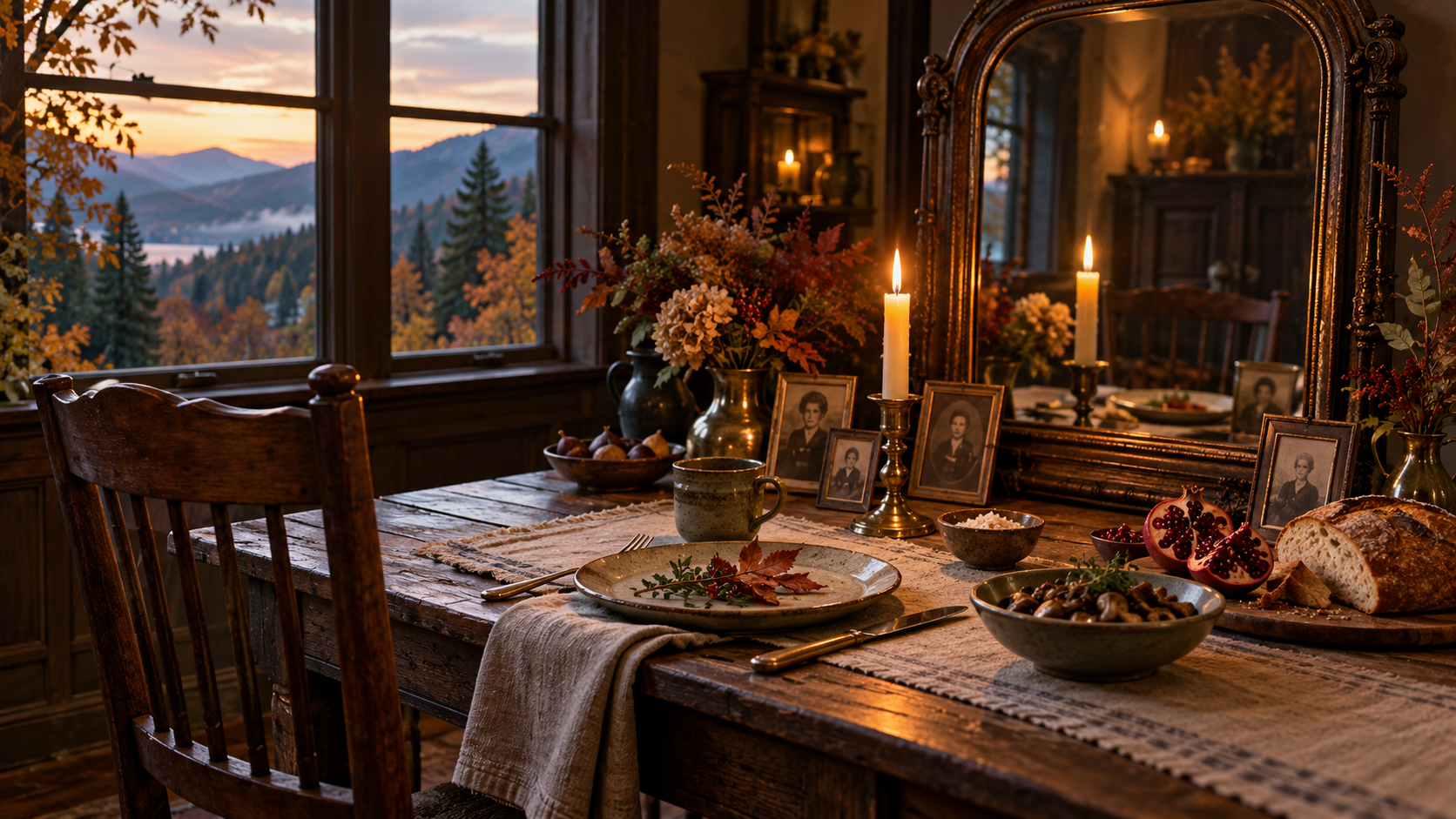
We also celebrate our Feast for the Departed at this time, and invite them to join us for a Dumb Supper. We have a mirror set up in which they may appear, as well as photographs of many of our “Honoured Dead” and spiritual ancestors, such as Lady Gwynne and certain members of her family, along with members of our Tradition who have passed over.
Should you wish to make a similar supper for your departed, it does not need to be an elaborate feast. A simple meal will do. Ours often includes some form of pork, mushrooms, and pomegranate arils, as well as a favoured dish of whichever departed ancestor is being honoured most that night.
A plate is set before the mirror or else at an empty chair for them, along with a candle, and the meal is taken in silence—hence the name “Dumb Supper,” meaning not speaking—until everyone has finished their meal.
A few minutes more of silence, and then our Honoured Dead are thanked for their presence and memory, and the candles are extinguished or left to burn to the socket, depending on the will of the group that night.
There is also another way to think about the ancestors and the mirror.
We may look into the glass and recognise a mother’s eyes, a grandfather’s expression, or a family resemblance that has become more apparent with the passing years. Sometimes we discover that we have begun making precisely the same face an elder once made at us. That can be a rather disconcerting moment.
Our spiritual ancestors leave their traces as well, although those may be more readily recognised in our words, our practices, and the things we teach than in the shape of our faces.
Looking into a mirror can therefore become an opportunity to consider what we carry. What have we inherited? What have we learned? What have we chosen to preserve, and what have we chosen to change?
And what will we, in our turn, leave to those who come after us?